Posts

Showing posts with the label Ancient science of India

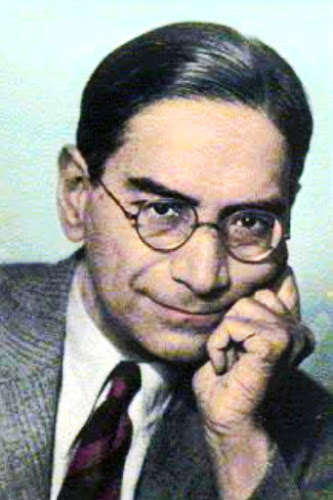
P.C. Mahalanobis

Image
             P.C. Mahalanobis   A well-known Indian statistician and scientist, Mahalanobis is greatly popular for introducing new methods of sampling. His most significant contribution in the field of statistics was the 'Mahalanobis Distance'. Besides, he had also made pioneering studies in the field of anthropometry and had founded the Indian Statistical Institute.  Originally, the family of Mahalanobis belonged to Bikrampur, Bangladesh. As a child. Mahalanobis grew up in an environment surrounded by socially active refoemers and intellectuals. He had his initial education from Brahmo Boys School Calcutta. Further, he enrolled himself into Presidency College and got a BSc degree with specialisation in physics. In 1913, Mahalanobis left for England for ther stodies and came in contact with S. Ramanujan, the famous mathematician from India. After completio...

P.C. Mahalanobis

Image
             P.C. Mahalanobis   A well-known Indian statistician and scientist, Mahalanobis is greatly popular for introducing new methods of sampling. His most significant contribution in the field of statistics was the 'Mahalanobis Distance'. Besides, he had also made pioneering studies in the field of anthropometry and had founded the Indian Statistical Institute.  Originally, the family of Mahalanobis belonged to Bikrampur, Bangladesh. As a child. Mahalanobis grew up in an environment surrounded by socially active refoemers and intellectuals. He had his initial education from Brahmo Boys School Calcutta. Further, he enrolled himself into Presidency College and got a BSc degree with specialisation in physics. In 1913, Mahalanobis left for England for ther stodies and came in contact with S. Ramanujan, the famous mathematician from India. After completio...

Birbal Sahni

Image
                  Birbal Sahni  The renowned paleobotanist, Birbal Sahni, was born on 14 November 1891 at Shahpur district, now in Pakistan. He was the third son of Ishwari Devi and Lala Ruchi Ram Sahni. He studied at the Government College, Lahore and Punjab University and graduated from Emmanuel College, Cambridge in 1914. After completion of his education, Birbal Sahni came back to India and worked as professor of botany at Banaras Hindu University, Varanasi and Punjab University for about a year. In 1920, he married Savitri Suri, who took an interest in his work and was a constant companion.  He studied the fossils of the Indian subcontinent. He was the founder of Birbal Sahni Institute of Palaeobotany, Lucknow. Palaeobotany is a subject that requires the knowledge of both botany and geology. Birbal Sahni was the first botanist to study extensively about...

Acharya Prafulla Chandra Ray

Image
Acharya Prafulla Chandra Ray  Acharya Prafulla Chandra Ray was born on 2 August 1861 in Khulna district in present-day Bangladesh. His father Harish Chandra Ray was a land proprietor, Up to the age of nine, Prafulla Chandra studied in a school in his village. In 1870, his family migrated to Calcutta, and Ray and his elder brother were admitted to Hare School. When in the fourth standard, he suffered from a severe attack of dysentery and had to postpone his studies for a couple of years and return to his ancestral home in the village. However, hie utilized this time in reading literature.  A pioneer in chemical research in India, Prafulla Chandra Ray joined the Presidency College as a lecturer in chemistry in 1889 after completing higher- education at the Edinburgh University. With the help of a renowned French chemist,Berthelot, he did commendable research work in Ayurveda. In 1892, he founded Beng...

Jagadish Chandra Bose

Image
        Jagadish Chandra Bose Jagadish Chandra Bose was born on 30 November 1858 in Mymensingh (now in Bangladesh). His father Bhagaban Chandra Bose was a deputy magistrate. Bose received early education in a vernacular village school. He was sent to Kolkata at the age of 11 to learn English and was educated at St. Xavier's School and College. He was a brilliant student. He passed his Bachelors in physics in 1879.  In 1880, Bose went to England. He studied medicine at London University for a year but gave it up because of his ill health. Within a year, he moved to Cambridge to take up a scholarship to study Natural Science at Christ's College, Cambridge. In 1885, he returned from abroad with a BSc degree and Natural Science Tripos (a special course of study at Cambridge). In 1894, Jagadish Chandra Bose decided to devote himself to pure research. He converted a small enclosure adjoining a b...

Aryabhatta

Image
                    Aryabhatta Aryabhatta the earliest known mathematician and astronomer of India. The birth place of Aryabhatta, who lived between circa 476-550 CE, is still a mystery. While many believe that he was born in Pataliputra in Magadha, present-day Patna in the state of Bihar, others are of the view that he was born in Kerala and lived  Magadha at the time of the Gupta rulers. His works include the Aryabhamiya (499 CE, when he was 23) and the Arya Siddhanta.  His most famous work, Aryabhatiya is a detailed text on mathematics and astronomy. The mathematical part of the Aryabhatiya covers arithmetic, algebra and trigonometry. It also contains continued fractions, quadratic equations, sums of power series and a table of sines. Aryabhatta is believed to have written at least three texts on astronomy and wrote some f...

Bhaskara II

Image
                    Bhaskara II Bhaskara II, also known as Bhaskaracharva, was born in 1114 CE near Vijjaydavida or present-day Bijapur in the state of Karnataka. Born to a family of scholars, he learnt mathematics from his astrologer father Mahesvara. A leading mathematician of twelth century, he wrote his first work on the systematic use of the decimal number system. He also headed the astronomical observatory at Ujjain, a leading mathematical centre of ancient India.  His main work Siddhanta Shiromani, which has four parts, namely, Lilavati, Bijaganita, Grahaganita and Goladhaya deals with arithmetic, algebra, mathematics of the planets and spheres, respectively Bhaskara is particularly known for the discovery of the principles of differential calculus and its application to astronomical problems and computations. While Newton ...

Sushruta

Image
                      Sushruta An ancient Indian surgeon from almost 2500 years ago, Sushruta made numerous contributions to the field, of surgery. Sushruta is regarded as  the Father of Surgery. In his book Sushruta Samhita, he described over 300 surgical procedures, 120 surgical instruments and classified human surgery categories. He lived, taught and practised his art on the banks of the Ganges which is now called Varanasi in North India.  Some of his contributions include surgical demonstration of techniques of making incisions, probing, extraction of foreign bodies, alkali and thermal cauterization, tooth extraction, excisions, and so on. He also described removal of the prostate gland, urethra, hernia surgery, caesarian section, and so on. He classified detail...

Dr. Har Govid Khorana

Image
          Har Govid Khorana Har Govind Khorana was born on 9 January 1922 in small village called Raipur in Punjab (now in Pakistan) and was the youngest of five siblings. His father was  a patwari, an agricultural taxation clerk in British India.   Khorana did his preliminary schooling at home. Later he joined the DAV High School in Multan. He graduated in science from Punjab University, Lahore, in 1943 and went on to acquire his Masters in science in 1945. He joined the University of Liverpool for his doctoral work and obtained his doctorate in 1948, He did postdoctoral work at Switzerland's Federal Institute of Technology, where he met Esther Sibler who became his wife. Later, he took up a job at the British Columbia Research Council in Vancouver and continued his pioneering work on proteins and nucleic acids.  Khorana joined the University of Wisconsin in 1960, and 10 years later, joined M...

Sir C.V. Raman

Image
                  Sir C.V. Raman Chandrasekhara Venkata Raman was born on 7 November 1888 at Tiruchirappalli, Tamil Nadu. His father, Chandrasekhara Iyer lecturer in physics, local college .His mother Parvati was a  home maker. He passes his matriculation when he was 12. He  joined Presidency College in Madras.He passed his bachelors and Masters examinations in Science with high distinction.He had a deep interest in physics. While doing his Masters, Raman wrote an article on physics and sent it to various scientific journals of England. On reading this article, many eminent scientists in London noted the talent of this young Indian. Raman wanted to compete for the ICS examination. But to write that examination, one had to go to London. As he was poor and could not afford it, he took the Indian Financial Service examination conducted in India. He was selected and posted at Rangoon, Burma (now Myanmar), which was then a part of Britis...

Indian Scientist

Image
              Sir Ronald Ross Ronald Ross was born in India in 1857 in Almora district located in present day Uttrakhand. His father was a General in the British army in India. Ross lived in India until was 8. Then he was sent to a boarding school in England. Studied medicine from St. Bartholomew Hospital in London. When Rose was small boy ,saw many people in India fall ill with malaria. At least a million people would die of Malaria due to lack of proper meditation .When Rose fathers fell seriously ill with Malaria, but fortunately recovered this deadly disease left an impression on age mind. When rows returned to India is part of the British Indian Medical Services, he was sent to Madras where a last part of his work was treating Malaria patient in the army. Ronald Ross in 1897 the long suspected link between mosquito and malaria. Confirmed the hypothesis.  Till date time, it was believed that Malaria is caused by breathing in bed and living in ...

Ancient Science

Image
Indian's contribution to Science Water management Indians had been developing water measurement techniques given before the Harappan time. Wells Ponds lakes dams and canals has been constructed with advanced Technologies throughout the historical timeline of the Indian .Civilization water has been used for storage drinking and purposes what occasion it is estimated that even today there are more student million man-made Ponds and lakes in India. Physics The concept of the atom can be traced to the vedic time .The material world was divided into 5 elements namely Earth (Prithvi ),fire (Agni ),air(Vayu), water( Jal )and Ether aur space (Akash) beyond Atom was considered to be the smallest particle which cannot be divided further. Nuclear energy is produced today splitting same. Medicine and surgery Ayurveda coma are you means life and Veda means knowledge. Oldest structure of Medical Science in the world, proper knowledge about various disease ,symptoms, causes and cure is the basis ...